How to play Commander in Magic: The Gathering
Commander is a multiplayer Magic format. Each deck has exactly one hundred cards including the commander, one copy of each card except basic lands, and is built around a legendary creature called the commander. It sits outside the deck and can be cast again and again during the game. Everyone starts at forty life, and most often four players sit around the table playing free-for-all.
Quick facts
| Deck size | Exactly 100 cards, including the commander |
|---|---|
| Copies per card | One, except basic lands |
| Starting life | 40 |
| Players | Two or more, most often four playing free-for-all |
| The commander | Usually a legendary creature |
| Losing without running out of life | 21 combat damage from the same commander |
| Allowed cards | Cards from all of Magic's history, except those on the banned list |
| Easiest way in | A preconstructed Commander deck |
The basic rules
The commander starts the game in the command zone, a separate zone next to the deck. From there you can cast it like any other card. If it goes to the graveyard or into exile, you may move it back to the command zone, and if it would go to your hand or library, you may put it there instead. So it is never gone for good. The cost is commander tax: each time you cast it from the command zone, it costs two more mana than the previous time.
The rest is regular Magic with two additions. Everyone starts at forty life instead of twenty, and a player who has taken a total of 21 combat damage from one and the same commander loses, no matter how much life they have left. Only combat damage counts, and damage from each commander is counted separately.
The commander is usually a legendary creature. The rules also allow certain legendary Vehicle and Spacecraft cards, and some cards state in their own text that they can be your commander.
Color identity
The commander determines which cards may be in the deck. Its color identity is the colors of all mana symbols on the card, both in the cost and in the rules text. Every card in the deck must stay within it. A commander with red and white symbols therefore gives a deck with only red, white and colorless cards, and a card with a blue symbol in its text is not allowed, even if it is otherwise red. It is the symbols that count, not color words in the text, and a hybrid symbol counts as both of its colors.
That is why choosing your commander is the first and biggest decision. More colors give more cards to choose from but require a mana base that can produce all the colors, and a colorless commander gives a deck with only colorless cards.
Two commanders
Some cards may share the spot. If two legendary creatures have the Partner ability, both can be commanders in the same deck, and the deck then gets all the colors the two have together. The ability comes in several variants. Partner with applies to two specific cards that belong together, and choose a Background lets a creature be paired with a Background card. Both commanders count toward the hundred cards, and there are never more than two.
Preconstructed Commander decks
Wizards releases preconstructed Commander decks, often called precons in English, and they are the usual way into the format. The deck is a hundred cards and playable straight out of the box. The commander is included as a foil card, and the deck contains new cards made for that release. What comes with it beyond the cards varies between releases, for example tokens, a deck box and sometimes a small pack of collector booster cards. Wizards describes the decks as a good way in for those new to the format.
Several releases also have a Collector's Edition of their decks, with the same card list but with all cards in foil. If you want to play, the regular deck is just as good.
Rebuilding a preconstructed deck
- Play the deck as it is a few times. That shows you which cards never do anything.
- Swap out around ten cards at a time, never the whole deck at once.
- Look over the lands first. More lands that produce two colors do more for a multicolor deck than any single powerful card.
- Stay within the commander's color identity. A card outside it is not allowed, however well it fits.
- Keep the new cards the deck's theme is built on. They are often the reason the deck works.
Power levels and rule zero
A Commander deck can be anything from a preconstructed deck with theme cards to an optimised deck that can win in just a few turns, and two such decks at the same table do not make for a fun game. That is why players talk before the game about how strong their decks are. This is called rule zero, after the idea that the group decides together what applies at the table. No one decides it alone.
Wizards has also introduced a voluntary system of levels, brackets, where players place their decks according to how strong they are and what they are built to do. The system includes the Game Changers list, cards considered able to turn a whole game around and that do not belong in the lowest levels. Neither the brackets nor the list are banning rules. They are there for the conversation before the game. Those who play to win at all costs play cEDH, competitive Commander, with the same rules and the same banned list.
History
The format was first called Elder Dragon Highlander, EDH, because each deck was originally led by one of the five Elder Dragons from the Legends set. It was created by the player Adam Staley in Alaska in the second half of the 1990s and spread among Magic judges, who played it after tournament days. Wizards renamed it Commander in 2010 and released the first preconstructed Commander decks in 2011. Since then the format has received its own releases, such as Commander Legends and Commander Masters, and since 2020 its own decks for most releases.
For a long time the rules were managed by an independent group, the Commander Rules Committee. In autumn 2024 the group handed over responsibility to Wizards, which has managed the format since then and calls it Magic's most popular.
Frequently asked questions
- How many cards are in a Commander deck? Exactly one hundred, including the commander. With two commanders, both are counted.
- Can I have two of the same card? No, only basic lands may be included in multiple copies.
- How many can play? Two or more. Four is the usual.
- Can a planeswalker be a commander? Only if the card itself says it can be your commander.
- Do I need expensive cards? No. The format is played at every price level, and a preconstructed deck is playable right away.
- Which deck box do I need? One that holds a hundred sleeved cards. See the guide to deck boxes.
- Are the new cards in Commander decks legal in Standard? No.
Common mistakes
- Counting the deck as a hundred cards plus the commander. The commander is one of the hundred.
- Including cards outside the commander's color identity, for example a hybrid card with a color the deck lacks.
- Forgetting commander tax when the commander is cast again.
- Counting damage from a spell toward the 21 limit.
- Bringing an optimised deck to a table of preconstructed decks without saying so first.
From our range
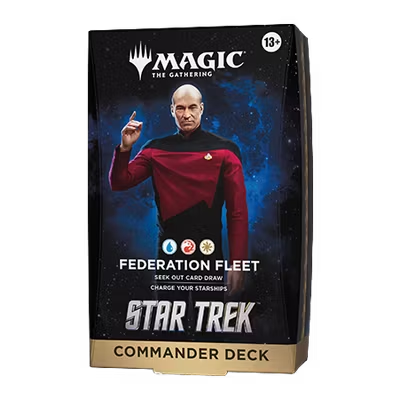 Trading card games
Magic: The Gathering Star Trek – Commander Deck: Federation Fleet
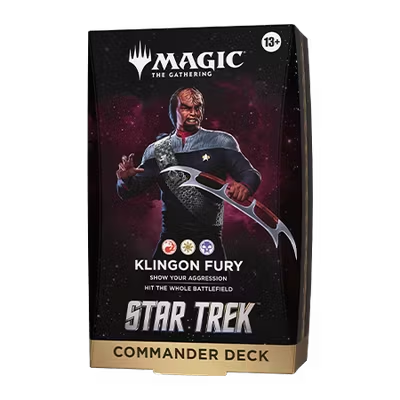 Trading card games
Magic: The Gathering Star Trek – Commander Deck: Klingon Fury
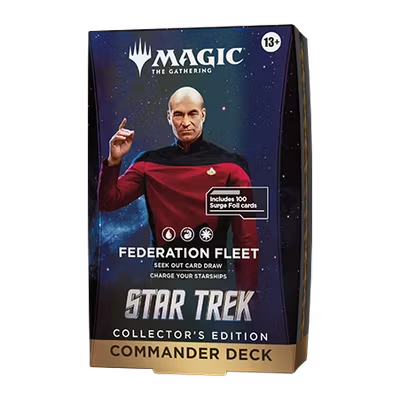
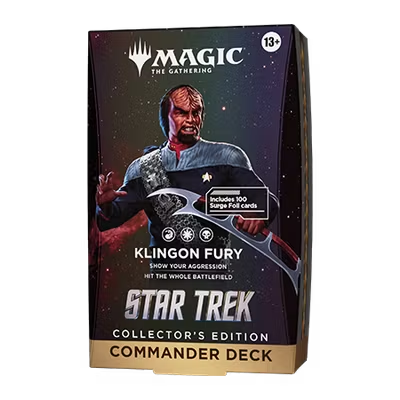
Read more about how Magic is played, the Magic sets and sleeves.
Shop: Magic and Commander decks at Bangerpack.
Written by those of us who run Bangerpack. Range and prices change continuously. What applies when you read this is shown in the category.